
Annual Report 2022-2023


Chairperson’s Message
It’s my pleasure to present the Annual Report for the Canada Agricultural Review Tribunal (CART or the Tribunal) for the fiscal year 2022-2023.
I started as Chairperson at CART in January of 2023 with two priorities: improving CART’s efficiency and its accessibility. To reach these goals, we’ve started to change the Tribunal’s operations.
Before I summarize this work, I want to thank CART’s hardworking team.
To CART’s adjudicators (Patricia Farnese, Geneviève Parent, and Marthanne Robson), executive director (Mijin Kim), registrar (Frédéric (Fred) Lapointe), senior counsel (Maria El Hachem), lawyers (Jean-François Cham, Mario Gosselin, Tamarah Nutik, and Princess Tino), and business administration officer (Claudia Larocque): Thank you so very much. Canadians are incredibly well served by your enthusiasm, skill, patience, and kindness! You have done, and continue to do, outstanding work.
Priority 1: Improving efficiency
On average, the through-time for files at CART is more than a year. Because “justice delayed is justice denied”, my top priority is to help the Tribunal become more efficient.
I believe we can improve the timeliness of our decision-making. Two of the ways we will do this is by simplifying our procedures and our decision-making.
Simplifying Procedures
Simplifying our procedures will help CART become more efficient. We have begun this process.
For example, we have reduced how many times the parties and Tribunal communicate with each other. We no longer write to the parties to tell them when we assign an adjudicator to a file. We no longer draft letters to accompany our decisions. We no longer need parties to tell us of their settlement discussions. Removing these steps allows our team to work on other tasks.
One major change to our process is that CART is now a virtual-first tribunal. This means that except in rare cases, we will hold our oral hearings by video conference call.
Being a virtual-first tribunal will allow us to hold our oral hearings much earlier. We won’t have to search for dates when our team is available to travel. It also means that taxpayers will save money because they will no longer pay for CART’s team to travel.
Simplifying Decision-Making
We have also simplified decision-making.
Our new Reasons Review Guideline prioritizes adjudicative independence and accountability. As a result, we no longer require draft decisions to go through a lengthy review process.
We are also creating a training manual for our adjudicators. It will cover basic administrative law principles and summarize the laws CART applies.
I believe that these changes will allow our decision-making to become timelier.
Priority 2: Improving Access to Justice
My second priority at CART is to improve the accessibility of our services.
As a result, shortly after I started, we completed the “Access to Justice Index for Federal Administrative Bodies” (A2J Index). The Department of Justice Canada created the A2J Index to help tribunals improve the accessibility of their services.
Unfortunately, the A2J Index report found that CART’s services are not very accessible.
Advisory Committee
The A2J Index’s report noted that CART does not conduct regular outreach activities.
As a result, we created an Advisory Committee of the Tribunal’s external stakeholders. We will be consulting with the Advisory Committee to get its views on how to improve our accessibility.
Writing Documents in Plain Language
We know that 83% of our applicants in 2022-2023 were self-represented. It can be difficult for these parties to understand CART’s procedures, or the laws CART applies.
And yet, our public documents are not written in plain language. As a result, we are rewriting our public documents so that more people can understand them.
Other A2J Initiatives
We have many other A2J ideas in the works. For example, we are creating an Accessibility Plan. We are creating training and performance measures for our adjudicators on accessibility. We are updating the accessibility of our website. And we are creating new tools for self-represented people.
We look forward to reporting on these initiatives to you in next year’s Annual Report.
Closing Thoughts
If you have ideas on how the Tribunal can become more efficient and accessible, please contact us. The more ideas we have, the better!
I’m profoundly honoured to be the Tribunal’s Chairperson and I can’t wait to see where CART’s next chapter brings us.
Sincerely,

Emily Crocco
Chairperson,
Canada Agricultural Review Tribunal
P.S.
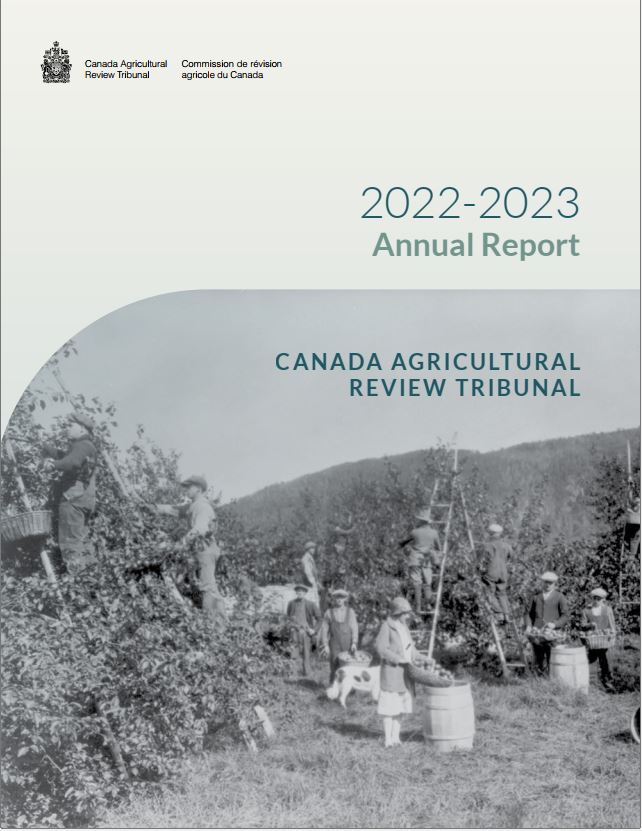
We've used old photos throughout this year's report to honour Canada's agricultural and agri-food history. We hope you enjoy them!
-E.C.
The Tribunal’s Jurisdiction and Mandate

The Canada Agricultural Review Tribunal (Tribunal or CART) determines the validity of administrative monetary penalties for violations of agriculture and agri-food laws.
The Tribunal is part of the Department of Agriculture and Agri-Food Canada’s (AAFC’s) portfolio. That said, CART is arm’s length from the AAFC and the rest of the Federal government. This means that CART makes its decisions independently from the government.
CART currently has three part-time adjudicators and a full-time Chairperson. The Governor in Council appoints CART’s adjudicators.
The Tribunal receives support from Administrative Tribunals Support Service of Canada (ATSSC). The ATSSC provides CART with registry, legal, and administrative support.
Summary of File Work
The Tribunal made significant progress in reducing its backlog this year, from 37 files at the start of the year to 20 files at the end of the year.
Recently, the Tribunal reviewed its statistics. During this time, we realized that the statistics we had previously reported were inaccurate. The chart below contains accurate numbers.
| 2022-2023 | 2021-2022 | 2020-2021 | |
|---|---|---|---|
| Total Open Files During Fiscal Year | 72 | 75 | 72 |
| Existing Files at Start of Fiscal Year | 37 | 38 | 51 |
| New Files Received | 35 | 37 | 21 |
| Files Closed During Fiscal Year | 52 | 38 | 34 |
| Withdrawn (Including settlements) | 15 | 5 | 17 |
| Inadmissible | 14 | 13 | 5 |
| Decisions on Merits | 23 | 20 | 12 |
| Hearings Held | 23 | 20 | 13 |
| Written Hearings | 14 | 8 | 7 |
| Oral Hearings | 9 | 12 | 6 |
| Open Files at End of Fiscal Year | 20 | 37 | 38 |

Parties’ Identities
In 2022-2023, 83% (or 29 out of 35) of the applicants in new files were self-represented.
In 2022-2023, the respondents in the Tribunal’s new files were:
- the Canada Border Services Agency in 13 files,
- the Canadian Food Inspection Agency in 12 files,
- the Minister of Public Safety and Emergency Preparedness in 8 files,
- the Minister of Health in 1 file, and
- the Minister of Agriculture and Agri-Food were respondents in one file.

Timeliness of CART’s Decision-Making
Of the 52 files we closed in 2022-2023, on average, it took:
- 371 total days for a file at CART to be processed (closed),
- 38 days to issue an admissibility decision,
- 433 days for CART to issue a decision when heard by written hearing,
- 650 days for CART to hold an oral hearing and another 139 days for a decision thereafter (for a total of 789 days), and
- 130 days to publish decisions online after they are issued.
Outcomes
Of the 23 merit decisions it made in 2022-2023, the Tribunal:
- upheld the notice of violation in 19 files, and
- set aside the notice of violation in 4 files.
Please click here to read the Tribunal’s decisions.

Initiatives

The Tribunal commits to improving the accessibility and timeliness of its services. In next year’s report, we will assess how the initiatives we describe below have met these goals.
Creation of Advisory Committee
In early 2023, we created an Advisory Committee for our stakeholders’ perspectives on how CART can work more efficiently and fairly.
The stakeholder members of the Advisory Committee for the 2023-2025 period are:
- Pierre Lampron, Chair of the Advisory Committee, President of the Dairy Farmers of Canada and Second Vice-President of the Canadian Federation of Agriculture,
- Robin Horel, Advisor of the Canadian Poultry and Egg Processing Council,
- Jorge Correa, Vice-President of Market Access and Technical Affairs of the Canadian Meat Council,
- Moya McAlister, Communications Manager of the National Self-Represented Litigants Project,
- Russell Reitsema, Vice-President of BC Young Farmers,
- Sherri-Lynn Foran, Director of Enforcement Appeals and Litigation Division at Canada Border Services Agency, and
- Melanie Nobre, Manager of National Enforcement and Investigations Office at Canadian Food Inspection Agency.


Completion of Access to Justice Index
In early 2023, the Tribunal took a survey called the “Access to Justice Index for Federal Administrative Bodies” (“A2J Index”). The A2J Index helps tribunals find areas where they can improve their accessibility.
The Tribunal’s results on the A2J Index were disappointing. Overall, CART received an accessibility score of 43%.
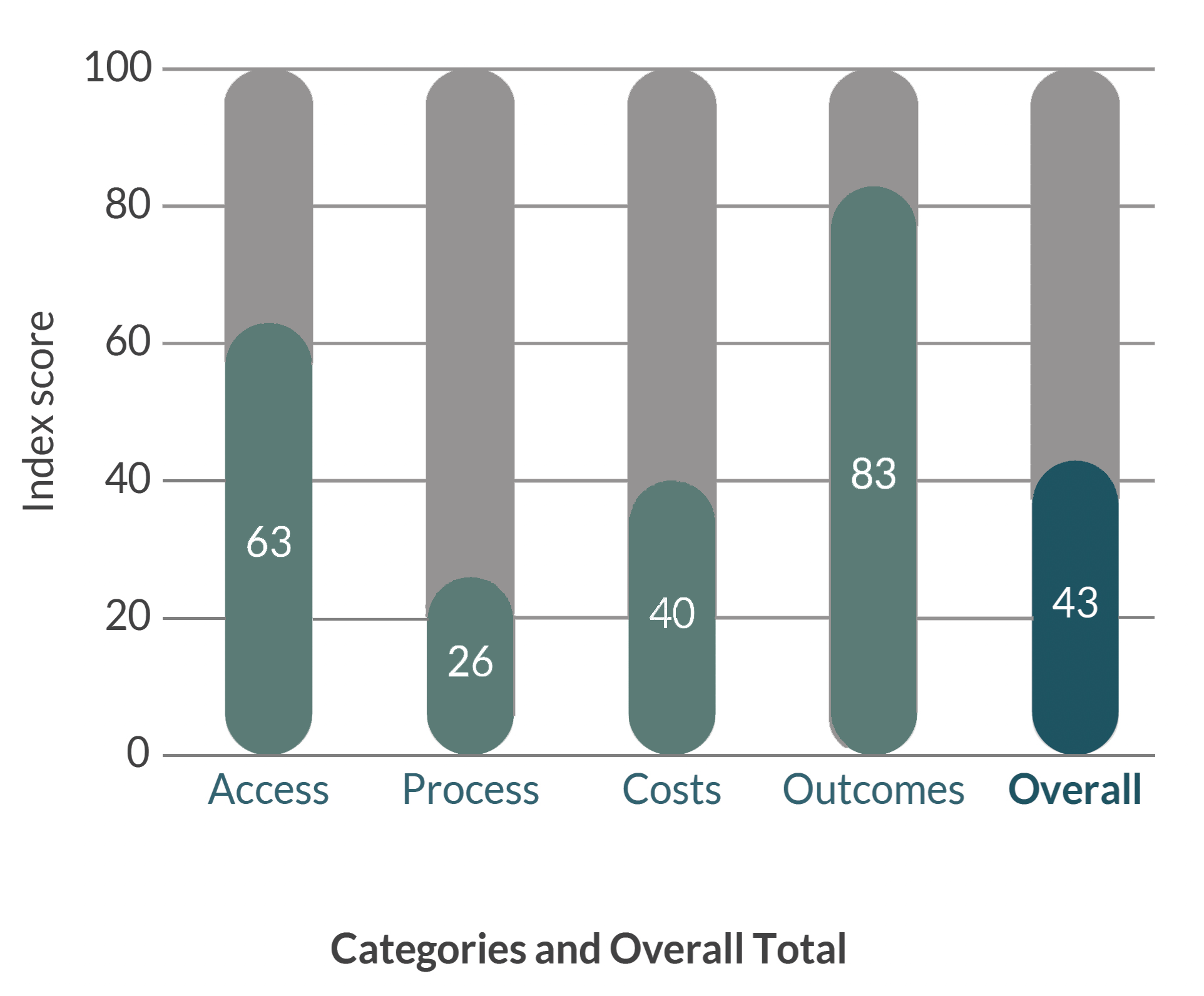
Some of the report’s key findings included the following.
Access to Administrative Body (score of 63%):
- CART’s website:
- is not written in plain language,
- does not contain audio or visual presentations, and
- does not meet government standards for Canadians with disabilities.
Processes (score of 26%):
- There is no dispute mechanism for complaints about CART’s services.
- Adjudicators and staff do not receive training on how to accommodate parties.
- CART does not refer self-represented parties to external support resources.
Costs (score of 40%):
- CART does not provide access to free public education and information material.
- CART does not provide mental health support or referrals.
Outcomes (score of 83%):
- CART does not request feedback.
- CART does not seek to improve the relationship damaged during the dispute.
Given this information, we are committed to improving CART’s accessibility.
A Virtual-First Tribunal
In February 2023, the Tribunal became a virtual-first tribunal. This means that with very few exceptions, CART’s oral hearings will now be heard by video conference call.
As a virtual-first tribunal, CART will be able to hold its oral hearings much earlier. We will also save thousands of dollars each year by not having to pay for CART’s team to travel across the country.
New Reasons Review Guideline
The Tribunal has begun a review of its internal policies and practices. We want to make sure our policies encourage timely, independent, and reasonable decision-making.
One change we made during the 2022-2023 year related to how we make, write, and communicate our decisions. Previously, every draft decision went to a committee for comprehensive feedback.
Not only did this significantly delay the timeliness of CART’s decision-making. It also threatened, at least in appearance, the independence of CART’s adjudicators.
As a result, in March 2023, the Tribunal created its Reasons Review Guideline. This Guideline protects the independence of adjudicators, who are no longer required to submit their drafts for feedback. We also expect that this will help CART make timelier decisions.
Creation of Comprehensive Training Materials
CART’s lawyers created training this year on the Safe Food for Canadians Act and the Health of Animals Regulations.
Training materials are especially important now that draft decisions are not sent to a committee for feedback.
As a result, CART’s lawyers are creating comprehensive training materials for CART’s adjudicators. For example, they are creating training about each penalty CART reviews. They are also drafting training for adjudicators on general topics like how to weigh evidence and how to run a fair hearing.
Developing Online Tools
Modernizing its technology is another way the Tribunal will increase efficiency and access to justice.
To do so, the Tribunal had previously identified the following key activities:
- complete the full implementation of the Tribunal’s electronic case management system (CMS);
- create an e-filing system for applicants to submit their requests for review; and
- create an online space where parties can exchange electronic documents.
We re-commit to finalizing these projects.

Financial Information
As previously mentioned, CART receives administrative support from the ATSSC.
During the 2021-2022 fiscal year, the ATSSC combined the secretariats of several of the Federal tribunals it supports. Along with four other tribunals, the ATSSC assigned CART to “Integrated Secretariat One”.
Because of this, most CART-specific financial data is no longer monitored separately. However, CART’s adjudicators’ salaries continue to be tracked separately.
The chart below shows the salaries of CART’s four adjudicators (including one full-time Chairperson and three part-time adjudicators).
| 2022-2023 | 2021-2022 | 2020-2021 | |
|---|---|---|---|
| Adjudicators’ Salaries | $305,696.00 | $313,845.00 | $280,036.00 |
For information on the ATSSC’s expenses, please see its financial reports or contact the ATSSC directly.

Contact Information
You can reach the Tribunal at the following coordinates:

- Our website
- cart-crac.gc.ca
- By email
- infotribunal@cart-crac.gc.ca
- By telephone
- 613-943-6405
- By fax
- 613-943-6429
- By mail
- Canada Agricultural Review Tribunal
344 Slater Street, 15th Floor, Suite 300
Ottawa, Ontario, K1A 0B7 - Our decisions
- decisions.cart-crac.gc.ca/cart-crac/en/nav.do
- RSS Feed
- decisions.cart-crac.gc.ca/cart-crac/en/rss/index.do
ISSN 2290-0578 (Print, English and French)
ISSN 2290-6193 (Online, English)
ISSN 2290-6207 (Online, French)