
Code of Conduct
Purpose and Application
- The Canada Agricultural Review Tribunal (CART) Members’ Code of Conduct (Code) governs the professional and ethical responsibilities of CART members.
- The Code applies to all full and part-time members of CART.
- This Code does not apply to Employees of the Administrative Tribunals Support Service of Canada (ATSSC).
- The Code complements and supplements any other requirements that are established for GIC appointees and set out in the applicable legislation, guidelines, codes, and policy instruments.
Scope and Administration
- The Code is based on CART’s mission to provide fair, impartial, accessible, and timely decisions about alleged violations of federal agriculture and agri-food legislation and regulations.
- The Code addresses Members' responsibilities to CART, to colleagues and staff, to the parties who appear before them, and to the public.
- CART’s Chairperson is responsible for the administration of the Code, including any matters related to its interpretation.
- Members are accountable to the Chairperson for compliance with the Code and encouraged to bring to the Chairperson’s attention any member conduct that does not comply with the Code or to seek direction or clarification when uncertain about the appropriate standard. Members may also consult with the Office of the Conflict of Interest and Ethics Commissioner on these matters.
Standards of Conduct
General
- Members must conduct themselves ethically and professionally while representing CART or undertaking their duties as CART members.
- Members must comply with the principles of procedural fairness, natural justice, and impartiality.
Accessibility
- Members must be aware and respectful of social, cultural, and other differences, and seek to accommodate those differences reasonably, whether dealing with parties in a proceeding, other CART members, or support staff.
- Members should make efforts to ensure CART is as barrier-free as possible and applying the principles and best practices of access to justice.
Collegiality
- Members must be collegial and treat everyone with courtesy and respect.
- Members must conduct proceedings in a courteous and respectful manner.
- Members must share their knowledge and expertise with their colleagues through a respectful exchange of views, information, and opinions.
Communications
- Members must abide by CART’s Members’ Communications Policy.
Compliance With Laws
- Members must follow all applicable laws, regulations, rules, policy instruments, and relevant legislation that apply to their and CART’s work.
- Members must not commit or condone an unethical or illegal act, or encourage anyone else to do otherwise.
Confidentiality
- Members must consider the privacy interests of individuals, ensuring that decisions contain only personal information that is necessary to explain the reasons for the decision.
- Members must protect the confidentiality of information that was obtained in their capacity as a CART member.
- Members must securely store and properly dispose of any physical or electronic documents received during Tribunal business.
Proceedings and Decision-Making Quality
- Members must be prepared for proceedings and conduct proceedings in a manner that is fair, orderly and efficient.
- Members’ decisions must reflect the relevant evidence and law.
Authority for Decision-Making
- Decision-making responsibilities cannot be delegated to someone unless that person has heard the evidence and is a CART Member. On this issue, please also refer to CART’s Reasons Review Guideline.
Expertise and Competence
- Members must maintain a high level of professional competence and expertise relating to the applicable legislation, regulations, policies, and caselaw.
- Members must maintain this expertise by participating in ongoing training provided by CART.
Timeliness
- Members must ensure procedures are appropriate and proportionate to the matter and apply active adjudication techniques and principles.
- Members must take reasonable steps to ensure that proceedings are concluded in a timely manner, avoiding unnecessary delays.
- Members must issue decisions as soon as possible after a hearing and are expected to meet applicable timelines, policies, and standards. On this issue, please see CART’s Service Standards.
Integrity
- CART members must approach their work with honesty, integrity, and high ethical standards, and must avoid impropriety or the appearance of impropriety in relation to their official CART duties and related professional interactions.
- Members must not misuse their position as a CART member to gain a personal benefit.
Impartiality and Bias
- Members must be impartial and conduct themselves in a manner that will not cast doubt on their ability to perform their duties objectively. On this issue, Members should refer to the Conflict of Interest Act.
- Members must approach every hearing with an open mind, and avoid doing or saying anything that would cause a reasonable apprehension of bias.
- Members must not be deterred by the prospect of disapproval from any person, institution, or community when proceeding in a manner that they conclude is based on the law and evidence.
- Members must recuse themselves from any file where they know or reasonably should know that, in the making of the decision, they would be in a conflict of interest, or that their participation may create a reasonable apprehension of bias. In such a case, they must immediately notify the Chairperson of their recusal.
- Members should consult with the Chairperson and/or their Conflict of Interest compliance advisor prior to engaging in outside activities that may be perceived as having a conflict of interest (i.e., conferences, training seminars, volunteer activities, teaching assignments, fundraising, involvement in other organizations, public speeches, and interviews).
The Code of Conduct is approved by CART’s Chairperson on October 10, 2024.
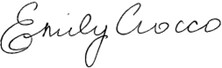
Emily Crocco
Chairperson
Canada Agricultural Review Tribunal