
Annual Report 2023-2024
Table of Contents
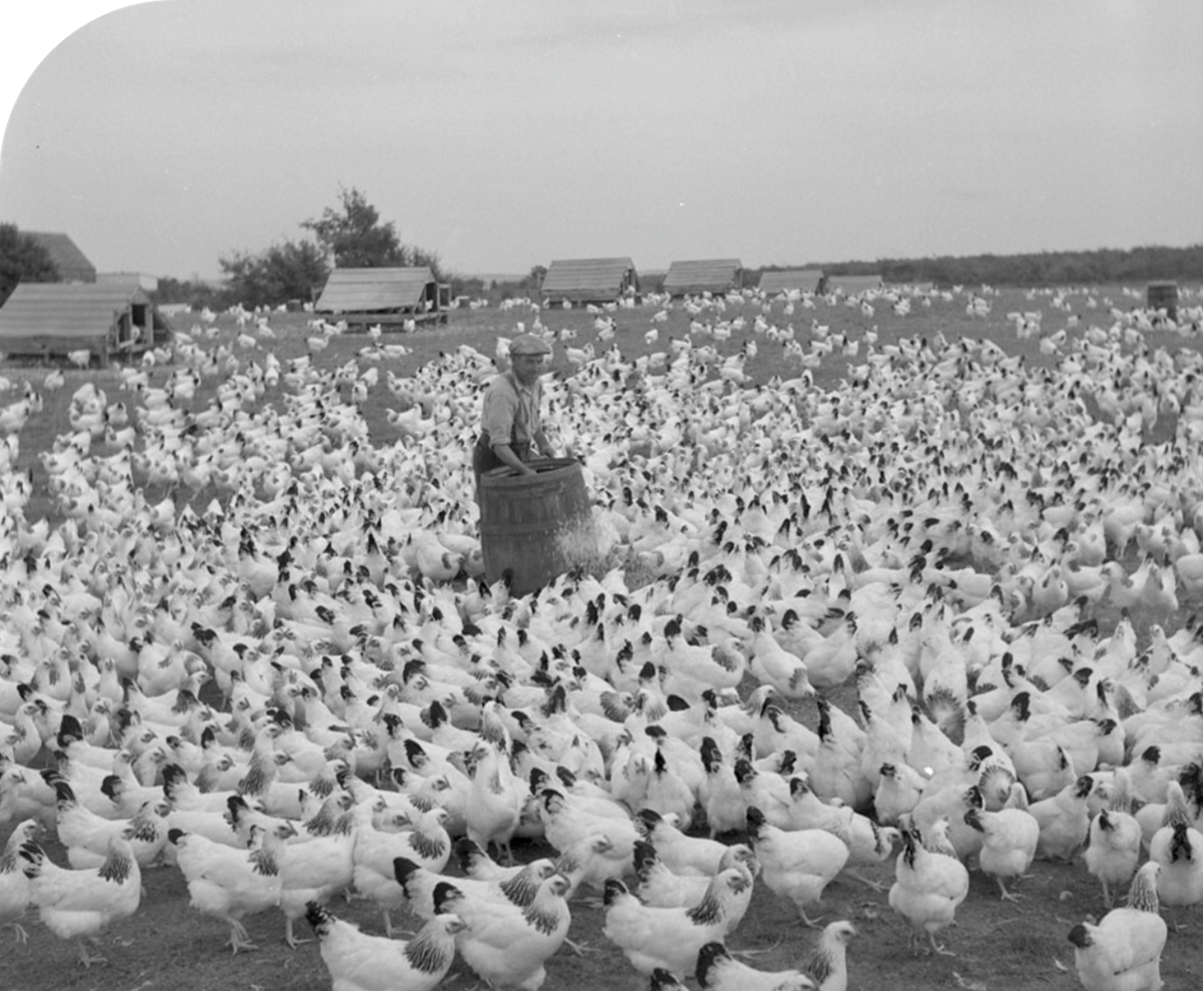
A man feeding 25,000 birds on a Nova Scotia poultry farm, between 1930-1960, Canada. Dept. of Manpower and Immigration / Library and Archives Canada.


Chairperson’s Message
It’s my pleasure to present the Annual Report for the Canada Agricultural Review Tribunal (CART) for the fiscal year 2023-2024.
Priority 1: Improving efficiency
This year, we became much more efficient in holding hearings and issuing decisions.
We benefited from many of the initiatives we took last year, including the simplification of our communications with parties and holding all oral hearings virtually. We also created and followed service standards and created more training for our adjudicators and lawyers.
Later in this report, we share the detailed statistics that demonstrate our improved efficiencies. For example, we became more efficient by:
- 24% when closing a file where an oral hearing was held;
- 104% when publishing decisions online after they were issued;
- 111% closing a file where a written hearing was held; and
- 121% when issuing decisions after oral hearings.
Priority 2: Improving Access to Justice (A2J)
My second priority at CART continued to be to improve the accessibility of our services.
E-Filing Portal
One important way that we have improved CART’s Access to Justice (A2J) was the launching of our e-filing portal.
CART’s e-filing portal is user-friendly and allows parties to have complete access to the official record from the opening to the closing of their file. It also provides a secure way for parties to submit and receive large volumes of documents.
Expert Advice on A2J
We hired an Access to Justice (A2J) expert to provide us with advice on how to improve CART’s A2J.
This expert reviewed our website, template documents, procedures, and the A2J Index report that the Department of Justice Canada issued about CART in early 2023.
In April of 2024, CART received the advice of the external A2J expert. I look forward to updating you on the work we have taken to implement the expert’s recommendations in next year’s Annual Report.
Closing thoughts
I am so proud of the thoughtful, enthusiastic, and hard work that CART performed in 2023-2024.
Going forward, if you have ideas on how we can continue to become more efficient and accessible, please contact us. The more ideas we have, the better!
Sincerely,

Emily Crocco
Chairperson,
Canada Agricultural Review Tribunal
CART’s Jurisdiction and Mandate

Examining section in McGregor's apiary alpine, 1913, Inglewood, Ontario, John Boyd / Library and Archives Canada.
CART determines the validity of administrative monetary penalties for violations of agriculture and agri-food laws.
CART is part of the Department of Agriculture and Agri-Food Canada’s (AAFC) portfolio. That said, CART is arm’s length from the AAFC and the rest of the Federal government.
This means that CART makes its decisions independently from the government.
There is one full-time Chairperson and three part-time adjudicators. The Governor in Council appoints the members of CART.
CART receives support from the Administrative Tribunals Support Service of Canada (ATSSC). The ATSSC provides CART with registry, legal, and administrative support.
Summary of File Work
CART reviews notices and decisions that have warnings or administrative monetary penalties relating to agriculture and agri-food. These reviews, referred to in this report as "casefiles" or simply "files", are initiated at the request of the person who received the original notice or decision.
Casefile Statistics
CART has reviewed statistics from previous fiscal years and has updated those statistics below to more accurately reflect our work.
| 2023-2024 | 2022-2023 | 2021-2022 | |
|---|---|---|---|
| Open Files During Fiscal Year | 62 | 72 | 75 |
| Files at Start of Fiscal Year | 20 | 37 | 38 |
| New Files Received During Fiscal | 42 | 35 | 37 |
| Hearings Held | 22 | 23 | 20 |
| Written Hearings | 4 | 14 | 8 |
| Oral Hearings | 18 | 9 | 12 |
| Files Closed During Fiscal | 31 | 52 | 38 |
| Inadmissible | 4 | 14 | 13 |
| Withdrawns | 13 | 13 | 1 |
| Decisions on Merits* | 14 | 23 | 20 |
| Outstanding Files at End of Fiscal Year | 31 | 20 | 37 |
*Of the 14 merit decisions it made in 2023-2024, the Tribunal:
- Upheld the notice of violation in 13 files
- Set aside the notice of violation in 1 file
Parties’ Identities
In 2023-2024, only 30% of applicants at CART had representation. By contrast, 100% of CART’s respondents were represented.
In 2023-2024, the respondents in the Tribunal’s new files were:
- The Canadian Food Inspection Agency (57%),
- The Minister of Public Safety and Emergency Preparedness (24%), and
- The Canada Border Services Agency (19%).
Timeliness of CART’s Decision-Making
In every key category this year, CART improved its timeliness, including:
- The time it takes for CART to close a file is now well under a year, representing a 37% decrease over last year, and a 43% decrease since 2021-2022.
- It now takes CART only 22 days on average to issue a decision following a written hearing. That’s approximately 90% less time than the two previous years, when the average was over 200 days.
- Following an oral hearing, it takes CART 31 days on average to issue a decision. That’s approximately 78% less time than the two previous years.
- Once a decision is issued, it takes CART an average of 41 days until the decision is published online. That’s 68% less time than last year, and 77% less than 2021-2022.
Japanese man and woman on tractor harvest sugar beets, ca. 1950, Imprial Oil / Library and Archives Canada / PA- 49563.
Three-Year Trends
Time efficiency processing caseload
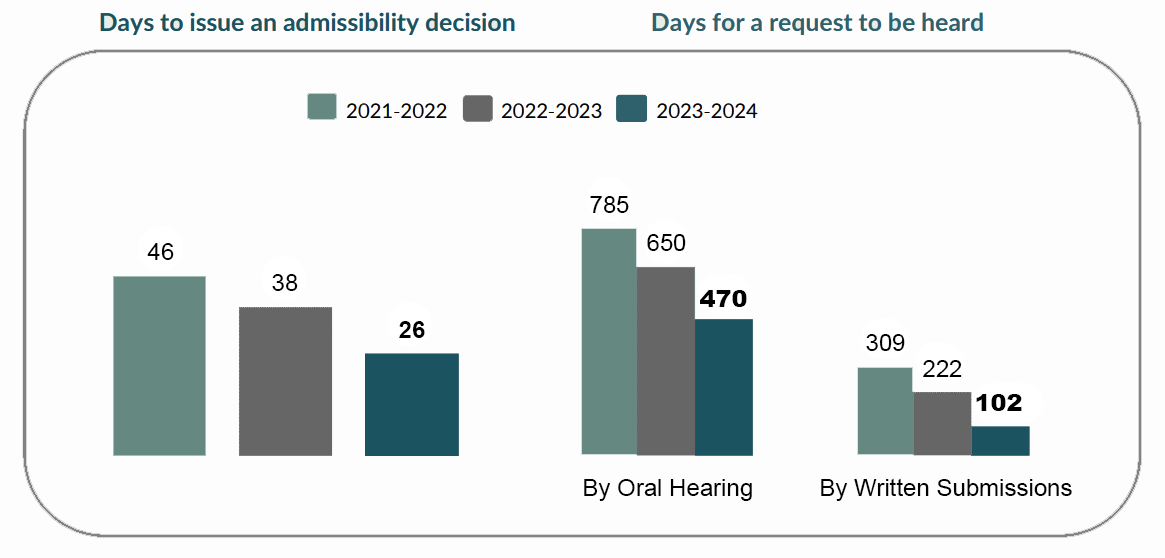
The title of this group of charts is “Three-Year Trends: Time efficiency processing caseload”
The first chart shows the number of days it took to issue an admissibility decision in the last 3 fiscal years:
- 2021-2022: 46 days
- 2022-2023: 38 days
- 2023-2024: 26 days
The second chart shows the number of days it took for a request to be heard in the last 3 fiscal years:
When proceeding by Oral Hearing:
- 2021-2022: 785 days
- 2022-2023: 650 days
- 2023-2024: 470 days
When proceeding by Written Submissions:
- 2021-2022: 309 days
- 2022-2023: 222 days
- 2023-2024: 102 days
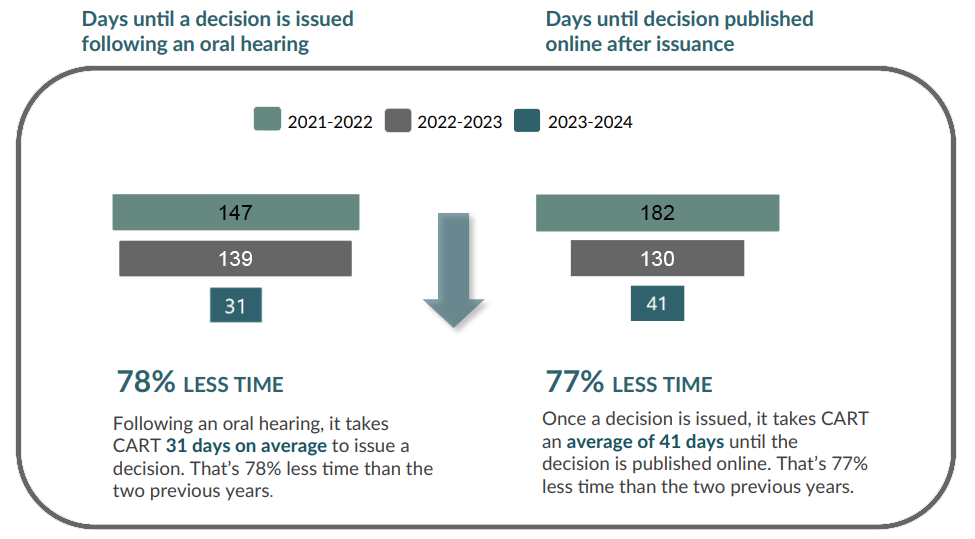
The title of this group of charts is “Three-Year Trends: Time efficiency processing caseload”
This third chart shows the number of days it took for a decision to be issued following an oral hearing in the last 3 fiscal years:
- 2021-2022: 147 days
- 2022-2023: 139 days
- 2023-2024: 31 days
Following an oral hearing, it takes CART 31 days on average to issue a decision. That’s 78% less time than the previous years.
The fourth chart shows the number of days it took for a decision to be published online after issuance in the last 3 fiscal years:
- 2021-2022: 182 days
- 2022-2023: 130 days
- 2023-2024: 41 days
Once a decision is issued, it takes CART an average of 41 days until the decision is published online. That’s 77% less time than the two previous years.
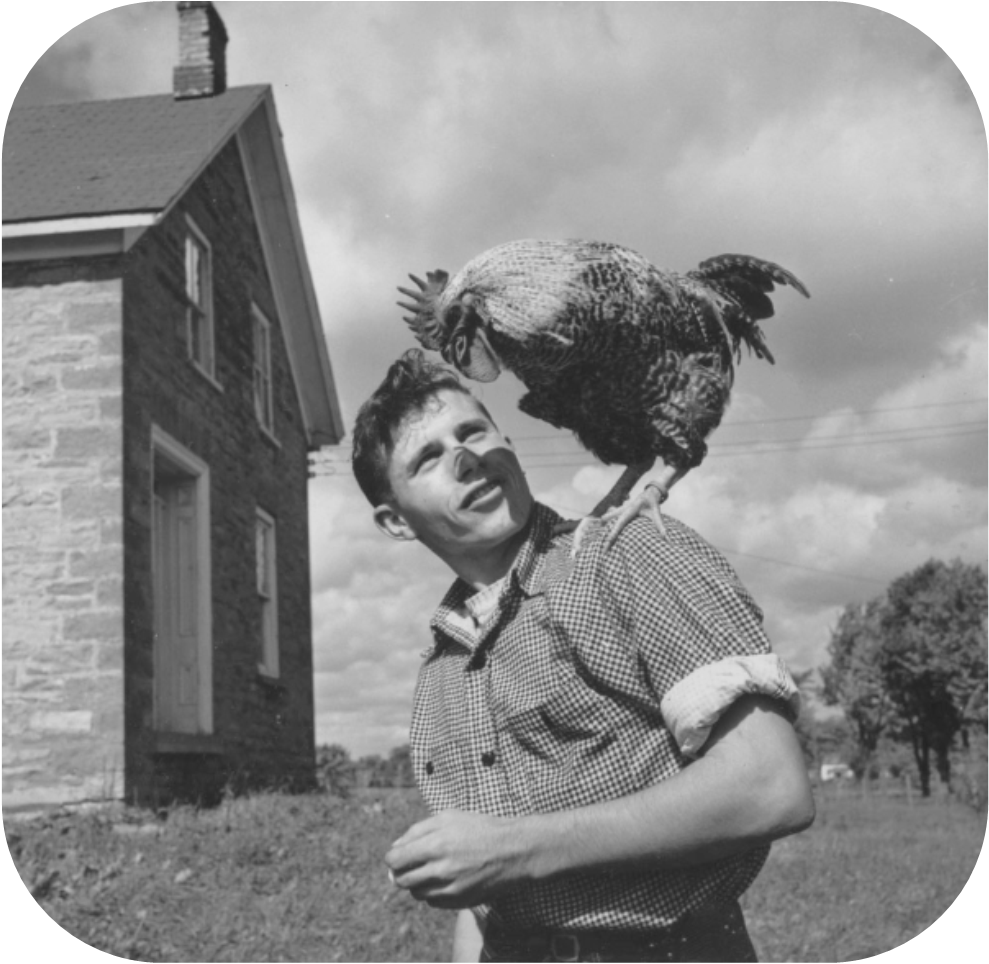
Henry Fisher, 1956, Library and Archives Canada / National Film Board fonds / e011176343.
Notable Cases
The following cases are examples of the variety of matters decided by CART. Please visit the CART website to read full versions of all the Tribunal’s published decisions.
False and Misleading Information on Certificate
Sadykow v Canadian Food Inspection Agency, 2023 CART 21 was about the alleged importation of regulated animals with a certificate that contained false or misleading information (a violation of section 13 of the Health of Animals Regulations) (HA Regulations).
The Applicant imported puppies from Poland into Canada with a permit requiring certification from an “official veterinary inspector”. The applicant provided certificates signed by someone who was not an official veterinarian, and which misled the reader into believing she was authorized to make the certifications. As a result, the Tribunal found that the applicant had provided certificates that were misleading and contained false information. CART upheld the violation of $10,000.
Violation not as Business, Penalty Recalculated
Zonnekeyn v Canadian Food Inspection Agency, 2023 CART 25 was about an Applicant who allegedly obstructed, hindered, or made a false or misleading statement to an analyst, inspector or officer, contrary to subsection 35(1) of the Health of Animals Act.
In attempting to export finches to the USA, the applicant had declared that the birds had been in Canada for at least 90 days. CART found that the applicant’s declaration was false. As a result, the violation was established.
However, the applicant’s business related to pigeons - not to finches. Moreover, the finches had been exported as a gift. As a result, CART reduced the penalty from $10,000 to $1,300 because the violation was not made in the course of a business or for profit.
Determining Animal’s Fitness at time of Loading
Hamel v Canadian Food Inspection Agency, 2024 CART 1 related to the alleged loading and transportation of a cow that was unfit, contrary to subsection 139(1) of the HA Regulations with a penalty of $13,000.
CART agreed that the evidence demonstrated the cow was unfit at the time the Respondent’s veterinarian conducted the ante-mortem and post- mortem assessment. However, CART determined that the evidence failed to establish the animal’s condition at the time of loading and transport. As a result, CART set aside the Notice of Violation.
Likelihood of Animals Suffering due to Meteorological or Environmental Conditions
S&G Bobcat Service Ltd. v Canadian Food Inspection Agency, 2023 CART 27 involved a warning for an alleged violation of section 146 of the HA Regulations, specifically relating to the confining of animals that are likely to suffer, be injured or die because of exposure to meteorological or environmental conditions. This decision is CART’s first assessment of a violation relating to section 146 of the HA Regulations.
CART determined that the applicant had loaded chickens onto modules that were covered in ice. When the ice melted during transit, the icy water dripped down into lower crates, causing the birds to become wet. CART concluded that it was likely the birds in the lower crates would suffer, be injured or die when they were placed into modules that would become soaked with icy water on a night where it was very cold outside. The warning was upheld.

Amber Valley, Alberta.
© Société canadienne des postes, 2021.
Admissibility where Request sent Electronically
In Prairie Pride Natural Foods Ltd v Canadian Food Inspection Agency, 2022 CART 21, CART had previously determined that this request was inadmissible since it did not comply with subsection 14(3) of the Agriculture and Agri-Food Administrative Monetary Penalties Regulations (AAAMP Regs). This provision states that if a request for review is sent to the Tribunal by fax or other electronic means, the applicant “shall” send a copy of the request by courier or registered mail within a prescribed time.
However, in its decision, the Federal Court of Appeal (FCA) in 2023 FCA 152 at para 25 determined that subsection 14(3) of the AAAMP Regs does not state that sending a copy is a requirement for making the request. The FCA then instructed CART to reconsider.
As a result of the FCA’s decision, CART determined in https://decisions.cart-crac.gc.ca/cart-crac/cart-crac/en/item/520967/index.do2023 CART 23 that the applicant’s failure to submit a copy of the request in accordance with subsection 14 (3) of the AAAMP Regs was not a barrier to the request being admissible. The file was then sent for determination on its merits.
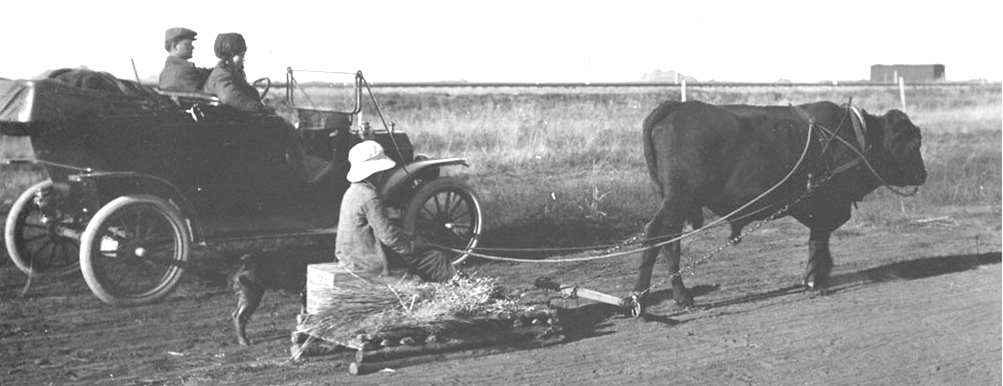
Scene near Moose Jaw, Saskatchewan, ca.1909, Rice / Library and Archives Canada
Access to Justice Initiatives
Chaired by Pierre Lampron, CART’s Advisory Committee of external stakeholders assists the Tribunal in ensuring that its procedures and practices are as fair, accessible, and efficient as possible.
Due to the Advisory Committee’s insights, we:
- Updated our Mission and Mandate,
- Published information about Accommodations,
- Created and published Service Standards,
- Published Mental Health Supports,
- Published How to Get Help With Your Request, and
- Published How members of the public can observe virtual hearings.
The external members of the 2023-2024 Advisory Committee were:
- Pierre Lampron, Chair of the Advisory Committee, President of the Dairy Farmers of Canada and Second Vice-President of the Canadian Federation of Agriculture
- Robin Horel, Advisor, and Skyler Veazey, Director of Regulatory and Technical Affairs, at the Canadian Poultry & Egg Processors
- Jorge Correa, Vice-President of Market Access and Technical Affairs at the Canadian Meat Council
- Moya McAlister, Communications, Manager at the National Self-Represented Litigants Project
- Russell Reitsema, Vice-Chair at BC Young Farmers
- Sherri-Lynn Foran, Director of Enforcement Appeals and Litigation Division at the Canadian Border Services Agency
- Melanie Nobre, Manager of National Enforcement and Investigations Office at the Canadian Food Inspection Agency
- Ryan Wilkes, Deputy Director of Portfolio Coordination in the Deputy Minister’s Office at Agriculture and Agri-Food Canada
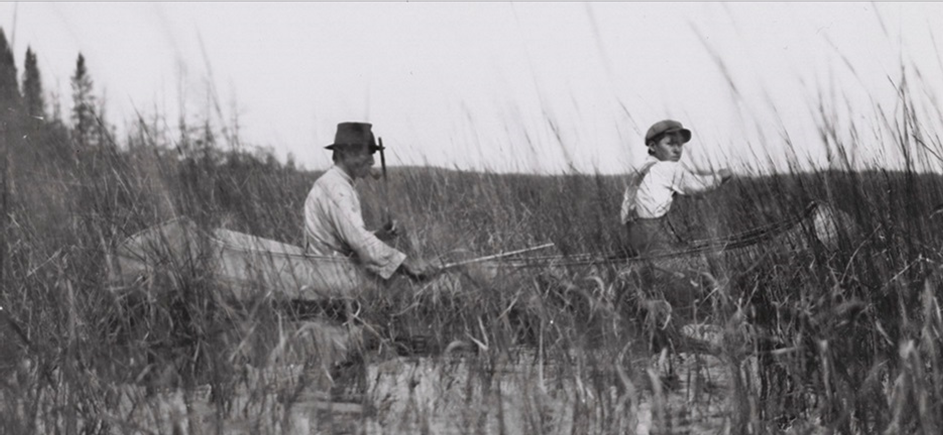
Harvesting manoomin (wild rice), 1919, Lac Seul, Ontario, Frederick Wilkerson Waugh / Library and Archives Canada/ Department of Indian Affairs and Northern Development fonds / e006078827.
Financial Information
Financial resources come from an integrated budget administered by the Administrative Tribunals Support Service of Canada (ATSSC).
Because of this, most CART-specific financial data is part of an amalgamated budget under ATSSC. However, CART’s adjudicators’ salaries continue to be tracked separately.
The chart below shows the salaries of CART’s four adjudicators (including one full-time Chairperson and three part-time adjudicators).
| 2023-2024 | 2022-2023 | 2021-2022 | |
|---|---|---|---|
| Adjudicators’ Salaries | $243,634 | $305,696 | $313,845 |
For information on the ATSSC’s expenditures, please see its financial reports or contact the ATSSC directly.
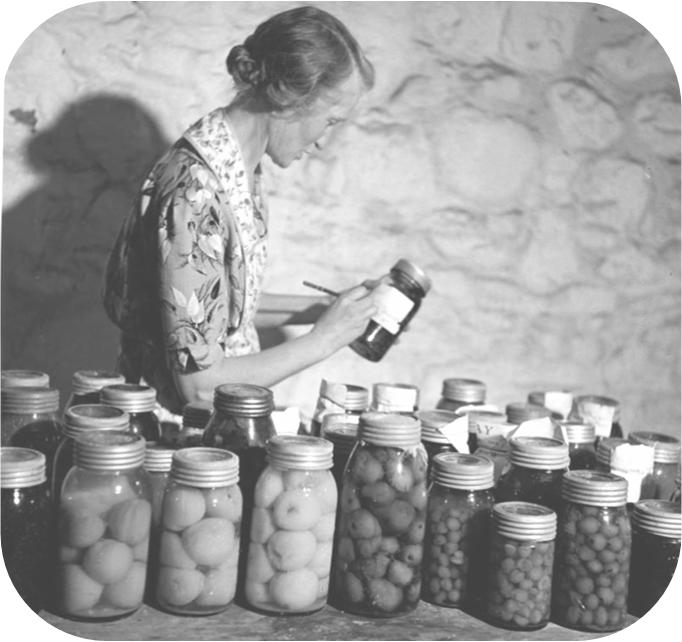
Farming Ontario, Mrs. Moran preparing winter's preserves, 1942, Ontario, Library and Archives Canada / Ronny Jaques.
CART's Teams
Many thanks to CART’s and the ATSSC’s hardworking teams, whose enthusiasm, skill, patience, and kindness serve Canadians incredibly well.
- Chairperson: Emily Crocco
- Adjudicators: Emily Crocco, Patricia Farnese, Geneviève Parent, and Marthanne Robson
- Executive Director: Mijin Kim
- Director of Member and Mandate services: Guillaume Phaneuf
- Senior Counsel: Maria El Hachem
- Legal Counsel: Tamarah Nutik, Jean-François Cham, Mario Gosselin, Jac Strandberg, and Princess Tino
- Registrar: Frédéric (Fred) Lapointe
- Registry Officers: Danielle Herbert and Claudia Larocque
- Senior Policy Advisor: Steven Artelle
- Project Manager: Robyn Edwards
- Business Administration Officer: Ramon Coligado
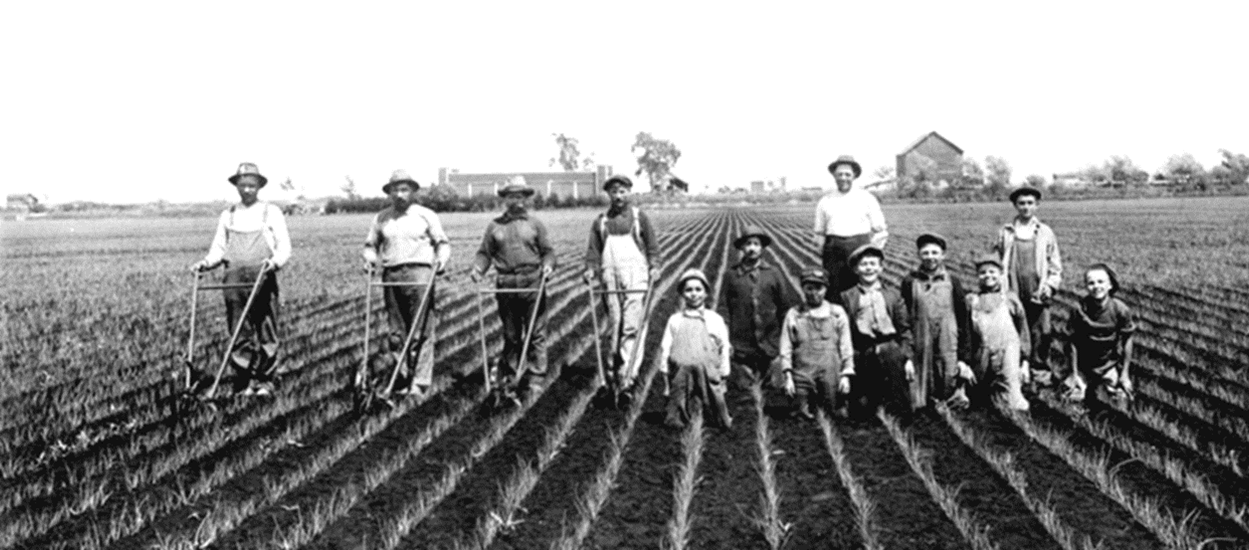
Weeding onions, Leamington, Ontario, 1920, Canada. Dept. of Interior / Library and Archives Canada / PA-043212 .
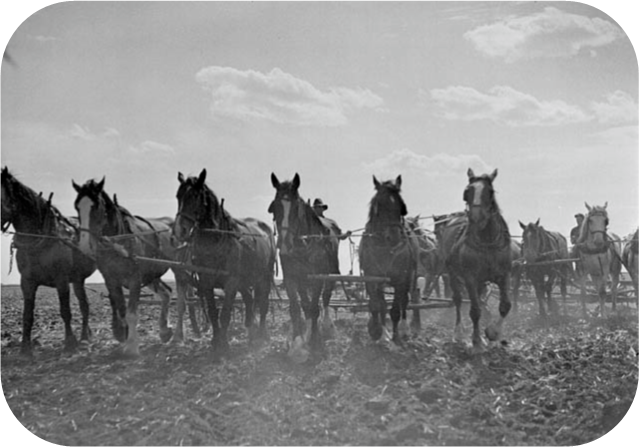
Farmers with team of horses work the wheat fields in Manitoba, 1933, Felix H. Man / Library and Archives Canada / PA-150338.
Contact Information
CART’s offices are located in the National Capital Region, the traditional unceded territory of the Algonquin Anishinaabe people.
You can reach the Tribunal at the following coordinates:
- Our website
- cart-crac.gc.ca
- By email
- infotribunal@cart-crac.gc.ca
- By telephone
- 613-943-640
- By fax
- 613-943-6429
- By mail
- Canada Agricultural Review Tribunal
344 Slater Street, 15th Floor, Suite 300
Ottawa, Ontario, K1A 0B7 - Our decisions
- Decisions - Canada Agricultural Review Tribunal (cart-crac.gc.ca)
- RSS FEED
- RSS Feeds - Canada Agricultural Review Tribunal (cart-crac.gc.ca)
ISSN 2290-0578 (Print, English and French)
ISSN 2290-6193 (Online, English)
ISSN 2290-6207 (Online, French)